Welcome to the new website for the Listening Technology Lab! Established in 2023, the lab focuses on technologies to enhance and augment human hearing. The research group is part of both the Department…
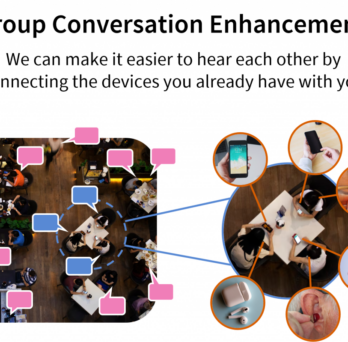
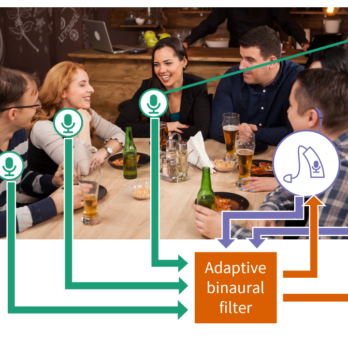
It’s often hard to follow group conversations in noisy environments like restaurants. In this paper, we make it easier for a group to hear each other by connecting everyone's smartphones and hearing devices together.
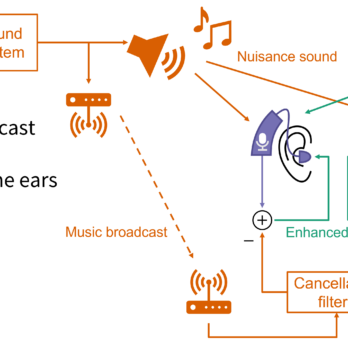
It is often difficult to hear over loud music in a bar or restaurant. What if we could remove the annoying music while hearing everything else? With the magic of adaptive signal processing, we can!
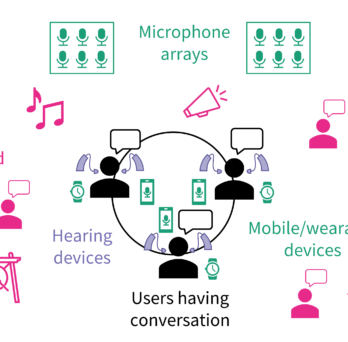
A group conversation enhancement system turns up the voices of users in the group while tuning out background noise, for example in a crowded restaurant.
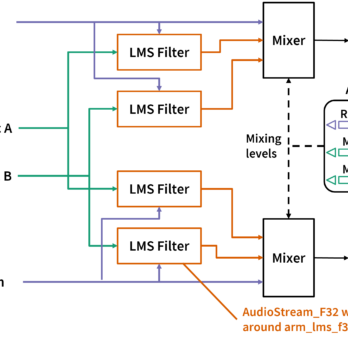
Our immersive remote microphone system makes it easier to hear multiple people in noisy situations. Here, we implement it on real hardware using the open-source Tympan platform.
Wireless remote microphones make it easier to hear by sending sound directly from the talker's mouth to the listener's ears, but they don't work well group conversations with multiple talkers. We propose an immersive system for group conversations.
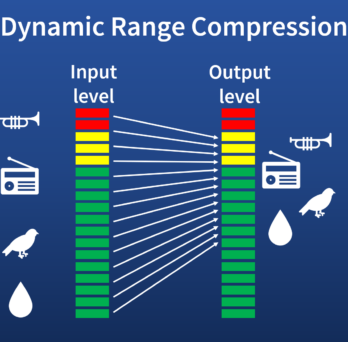
Every modern hearing aid uses dynamic range compression to control loudness, but compression can cause distortion in noisy places like restaurants. We developed a mathematical model explaining these distortion effects.
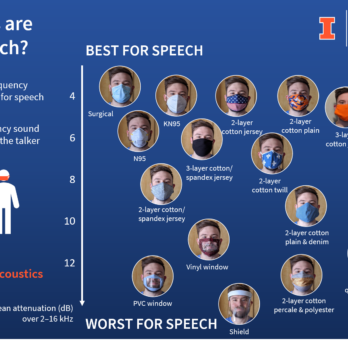
Face masks are important for public health, but they also make it harder to hear because they muffle high-frequency sound. We measured the acoustic effects of different types of face masks on speech and showed that well-placed microphones can help.
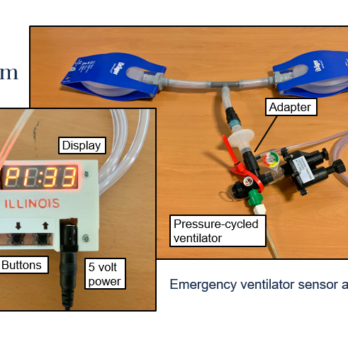
A team from the University of Illinois Urbana-Champaign developed a low-cost emergency ventilator for the COVID-19 pandemic. Our team adapted audio signal processing algorithms to create a simple, low-complexity alarm system for the ventilator.
Most spatial sound enhancement algorithms focus on source separation, but we can also remix sounds, changing their relative levels while preserving their spatial cues. Remixing systems are easier to build and suffer less from distortion.